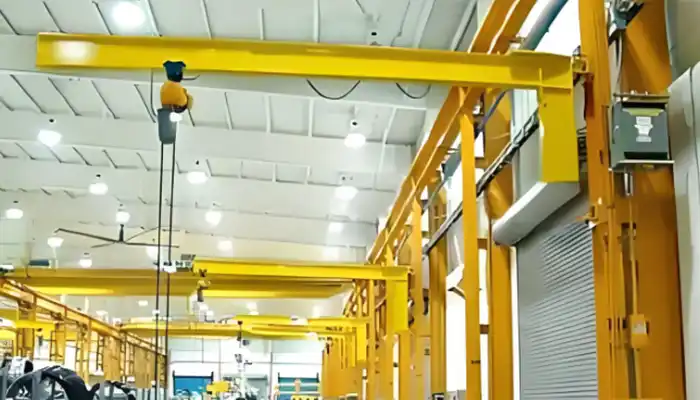
1–3 Ton Wall Travelling Jib Crane for Metal Processing and Manufacturing
menu_open
Content Quick Link
Most Important Takeaway
A 1–3 ton wall travelling jib crane provides dedicated lifting coverage along metal processing production lines, helping factories move shafts, pipes, cylinders, rollers, and fabricated parts safely between welding, machining, assembly, and inspection stations without occupying valuable floor space.
- A wall travelling jib crane moves along a wall-mounted runway beam and serves multiple workstations.
- It is suitable for 1 ton, 2 ton, and 3 ton lifting tasks involving cylindrical metal workpieces and fabricated steel components.
- The system reduces forklift traffic, manual handling, and waiting time for shared overhead cranes.
- Proper lifting fixtures are essential for safe handling of pipes, shafts, rollers, steel cylinders, and machined metal parts.
- The building wall, columns, brackets, and runway beam must be checked before installation.
- Hoist type, jib arm length, wall travelling distance, lifting height, and operating frequency should be confirmed before ordering.
- A customized wall travelling jib crane can improve production flow, positioning accuracy, workplace safety, and machine loading efficiency.
FAQ: Wall Travelling Jib Crane for Metal Processing Applications
Frequently asked questions about wall travelling jib crane systems used in metal fabrication, machining, and assembly workshops.
1. What is a wall travelling jib crane and how does it work?
A wall travelling jib crane is a wall-mounted lifting system that moves along a runway beam and serves multiple workstations in a production line. It lifts, travels along the wall, rotates the jib arm, and positions loads directly at welding, machining, or assembly stations. In simple terms, it brings lifting right to where the work is happening.
2. When is a 1–3 ton wall travelling jib crane suitable for metal processing?
It is suitable when material handling is frequent between nearby stations such as welding, CNC machining, and assembly. This capacity range is commonly used for steel cylinders, shafts, pipes, and fabricated components. Basically, it fits most daily workshop lifting tasks.
3. Can a wall-mounted travelling jib crane handle steel pipes, shafts, cylinders, and rollers?
Yes. It is widely used for cylindrical metal workpieces such as pipes, shafts, rollers, and hydraulic cylinders. With proper lifting attachments like clamps, slings, or V-block cradles, it ensures stable and safe handling. The key is using the right fixture for the shape.
4. How does a wall travelling jib crane improve welding and machining line efficiency?
It reduces waiting time between processes by enabling direct transfer from one station to another. Operators do not need forklifts or shared overhead cranes. Lift → move → place → next station, very direct flow. This improves productivity and reduces handling delays.
5. Should I choose a 1 ton, 2 ton, or 3 ton wall travelling jib crane?
It depends on total lifted load, including the workpiece and lifting tools.
- 1 ton: light components, tooling, small parts
- 2 ton: standard welding and machining production
- 3 ton: heavy components or future capacity margin
In practice, it is better to leave a safety margin instead of working at full limit.
6. Which hoist is better: electric chain hoist or electric wire rope hoist?
- Electric chain hoist: suitable for 1–2 ton, short height, compact workshops
- Electric wire rope hoist: suitable for 2–3 ton, higher lifting height, heavier loads
Chain hoists are simpler; wire rope hoists are more stable for heavy-duty work.
7. What lifting attachments are suitable for cylindrical metal workpieces?
Common attachments include pipe hooks, lifting clamps, C-hooks, V-block cradles, soft slings, and spreader beams. Selection depends on size, weight, and surface condition. Wrong attachment often causes instability even if crane capacity is enough.
8. Can the existing workshop wall or steel columns support a travelling jib crane?
It depends on structural strength. The wall, columns, brackets, and runway beam must be evaluated for load capacity and moment forces. If the structure is not sufficient, a steel support frame may be required. This step is always checked before installation.
9. What information is required for wall travelling jib crane design and quotation?
Key inputs include load capacity, workpiece details, lifting height, jib length, travel distance, workshop layout, power supply, and working conditions. A simple layout sketch is usually enough for initial design. Clear layout helps faster and more accurate quotation.
1–3 Ton Wall Travelling Jib Crane for Metal Processing and Manufacturing: Complete Practical Buyer Guide
Introduction: Why Metal Processing Lines Need Localized Lifting
A 1–3 ton wall travelling jib crane is designed for metal processing workshops that need fast, localized, and accurate material handling along a production line. It helps transfer cylindrical metal workpieces, steel pipes, rollers, shafts, fabricated components, and welded assemblies between cutting, welding, machining, inspection, and assembly stations.
What Is a Wall Travelling Jib Crane?
A wall travelling jib crane is a jib crane mounted on a wall-supported runway beam. The jib arm travels horizontally along the wall, while the hoist moves along the jib arm to cover multiple workstations.
The crane provides four main movements:
- Vertical lifting and lowering by electric hoist
- Hoist trolley travel along the jib arm
- Jib arm slewing for load positioning
- Wall travelling movement along the runway beam
This configuration is also called a wall mounted travelling jib crane, travelling wall jib crane, wall running jib crane, or wall bracket jib crane with travelling system.
Common Problems Solved in Metal Manufacturing Workshops
A wall travelling jib crane is suitable when production teams experience frequent handling delays, unsafe manual lifting, or congestion around welding and machining stations.
Typical Material Handling Problems
- Workers manually lifting or guiding heavy steel parts
- Forklifts entering narrow welding or machining areas
- Shared overhead cranes causing waiting time between production steps
- Cylindrical metal workpieces rolling, swinging, or shifting during transfer
- Damage to precision-machined shafts, rollers, or cylinders
- Limited floor space for a freestanding jib crane
- Repetitive lifting between production stations along one workshop wall
- Slow loading and unloading of CNC machines, lathes, drilling machines, and welding fixtures
Practical Decision Question
If your factory needs to move 1 ton, 2 ton, or 3 ton metal workpieces repeatedly along one side of the workshop, a wall travelling jib crane may provide a more efficient alternative to manual handling, forklifts, or a larger overhead bridge crane.
Practical Decision Question
If your factory needs to move 1 ton, 2 ton, or 3 ton metal workpieces repeatedly along one side of the workshop, a wall travelling jib crane may provide a more efficient alternative to manual handling, forklifts, or a larger overhead bridge crane.
Best Applications for a 1–3 Ton Wall Travelling Jib Crane
A 1–3 ton wall travelling jib crane is usually installed along a production line where material movement happens every day, repeatedly. Not for occasional lifting, but for routine transfer between stations. In many metal workshops, steel fabrication plants, and machining factories, this type of wall travelling jib crane for manufacturing line handling is placed beside welding zones, CNC machines, and assembly benches so operators can move parts without waiting for a bridge crane or forklift.
It is simple in structure. One crane, one wall line, multiple working points. That’s the basic idea. Simple, but very practical in daily work.
Cylindrical Metal Workpiece Handling
In many metal processing plants and fabrication workshops, the most common loads are round or long components. Pipes, shafts, rollers—these are not easy to handle manually because they roll, slip, or shift during lifting. Operators usually say, “these parts never stay still.”
A wall travelling jib crane for cylindrical workpieces handling is widely used for lifting and transferring:
- Steel pipes and tubes
- Hydraulic cylinders
- Steel shafts and drive shafts
- Metal rollers and conveyor rollers
- Steel drums and pressure components
- Fabricated cylindrical shells
- Round bars and billets
- Machine components with round geometry
- Cast steel parts after machining or rough forming
- Welding assemblies with cylindrical structure
For these loads, operators rarely rely on a single hook only. In industrial workshop operation, different lifting attachments for wall travelling jib crane systems are selected depending on shape, weight, and surface condition.
- Pipe hooks for long tubular steel
- Lifting clamps for controlled gripping of cylinders or pipes
- C-hooks for rollers or coils
- V-block lifting cradles for shafts and precision round parts
- Soft slings when surface protection is needed
- Spreader beams for long and heavy cylindrical loads
- Custom lifting fixtures for irregular or special geometry parts
In practice, the attachment is just as important as the crane itself. If the fixture is not correct, the load can tilt or rotate slightly during travel—even if the 1–3 ton capacity wall travelling jib crane is more than enough. And yes, this is something most workshops learn the hard way.
Welding and Fabrication Stations
A wall travelling jib crane for welding workshop applications is usually installed directly along welding lines or fabrication bays. The goal is not long-distance transport. It is short, repeat lifting between nearby stations.
Typical movement is simple and repetitive: rack → welding station → welding positioner → next bench.
Common stations served include:
- Manual welding stations
- Robotic welding cells
- Pipe welding stations
- Welding rotators and pipe positioners
- Fabrication benches for structural steel
- Assembly fixtures for pre-weld alignment
In many workshops, workers used to push, drag, or manually reposition heavy steel parts. That method is slow, not stable, and honestly quite tiring.
With a wall mounted travelling jib crane, the operator can lift the part, move along the runway beam, rotate the jib arm, and place it directly into the welding fixture. No extra pushing. Less physical strain. More controlled handling. Much easier, you feel it immediately on the floor.
Another practical point: welding areas are often tight. Space is limited. A floor-mounted crane would block movement paths. Here, the wall travelling jib crane design keeps the floor open, so welding, grinding, and inspection can continue without interference.
CNC Machine and Metalworking Equipment Loading
In machining workshops, a wall mounted jib crane for CNC machine loading and unloading is often installed near lathes, milling machines, drilling machines, and grinding equipment.
The reason is simple. CNC machines do not only need lifting—they need accurate positioning into chucks, fixtures, or machine tables. It’s not just “lift and drop,” it’s “place it exactly right.”
Typical equipment served includes:
- CNC machining centers
- CNC lathes and turning machines
- Milling machines
- Drilling machines
- Grinding machines
- Cutting machines
- Press brake machines
- Metal bending equipment
- Surface treatment and finishing machines
Here the key requirement is stability. The crane must move smoothly, without sudden start or stop. That is why many setups use VFD controlled wall travelling jib crane systems or slow-speed hoists.
In industrial operation, the handling sequence is usually like this:
Lift the workpiece → travel along wall → align with machine opening → rotate jib → lower slowly into fixture.
That last step is the most important. If the load swings or drops too quickly, it can damage the machine chuck or scratch the machined surface. Operators usually slow down instinctively here—because they know there is no room for mistake.
So for CNC applications, the crane is not just about capacity (1 ton, 2 ton, or 3 ton wall travelling jib crane). It is industrially about controlled motion, positioning accuracy, and surface protection.
Assembly, Inspection, and Packaging Areas
A wall travelling jib crane for assembly line support is commonly used after machining and welding, where parts need final handling, inspection, or packing before dispatch.
Typical operations include:
- Mechanical assembly of metal components
- Quality inspection and measurement stations
- Final testing areas for hydraulic or mechanical parts
- Surface coating preparation and handling zones
- Packaging and dispatch preparation areas
At this stage, most parts are finished or semi-finished. That means surface condition becomes critical. Scratches, dents, or pressure marks are not acceptable anymore.
So operators typically use:
- Soft slings for coated or polished parts
- Protective sleeves on lifting chains or hooks
- Custom padded lifting hooks for sensitive surfaces
- Balanced lifting beams for stable orientation
In packaging areas, speed also matters. The crane helps reduce waiting time between inspection and packing, especially when multiple components move in sequence through the same line.
The layout is usually practical: inspection table on one side, storage or packing zone on the other side of the wall line. The wall travelling jib crane system connects these points directly, without blocking walking paths or forklift lanes.
Practical Note for Buyers
In industrial factory use, the performance of a 1–3 ton wall travelling jib crane in metal manufacturing applications depends on three very practical decisions:
- Correct matching of lifting attachment with cylindrical or irregular workpieces
- Proper selection between electric chain hoist and wire rope hoist based on duty cycle and lifting height
- Clear planning of wall travel length and workstation spacing along the production line layout
If these three points are aligned, the crane runs smoothly in daily operation and becomes part of the production rhythm. If not, even a well-designed crane can feel limited in industrial use.
How a Wall Travelling Jib Crane Works on a Metal Production Line
A wall travelling jib crane for metal production line handling works in a very direct, very "on-the-floor" way. It follows the actual flow of production—move the part from one station to the next, step by step. No unnecessary handling. Simple, but effective.
In most metal workshops, especially in steel cylinder manufacturing, hydraulic equipment fabrication, and general metal machining plants, the crane is installed along one wall. Multiple stations are arranged in a line—welding, machining, inspection, sometimes assembly.
So the idea is straightforward: one crane, one wall, many work points. You know, one system doing a few jobs instead of waiting for multiple machines.
The crane does not replace the overhead crane. It is more like a "local helper" for repeated lifting inside one production zone.
Example: Steel Cylinder Transfer From Welding to Machining
A very common case is a workshop producing steel cylinders for hydraulic equipment. These parts are heavy, long, and need careful positioning. If you handle them manually or with a forklift, it gets slow and a bit risky. Operators usually say: "too heavy to push, too delicate to drop."
So the wall travelling jib crane operation process in a metal fabrication workshop goes like this:
- Steel cylinders are stored near the cutting area or raw material rack
- The operator attaches a lifting tool—like a pipe lifting clamp, soft sling, or V-shaped lifting cradle, depending on size and surface condition
- The crane lifts the cylinder vertically using the electric hoist, keeping it stable (no shaking, no sudden movement)
- The operator moves the wall travelling jib crane along the runway beam toward the welding station
- Once in position, the jib arm rotates to line up the cylinder with the welding fixture or welding rotator
- The load is lowered slowly into place for welding setup
- After welding is finished, the same crane lifts the cylinder again from the welding station
- The crane travels along the wall to the CNC machining center or turning machine area
- The jib arm rotates again to align the cylinder with the machine chuck or fixture
- The workpiece is lowered slowly into machining position
- After machining, the finished component is moved to inspection, assembly, or packing area
This whole cycle repeats again and again during production.
Why This Flow Matters in industrial Production
In industrial metal processing and manufacturing operations, the value of a 1–3 ton wall travelling jib crane system is not just lifting power. It is how it changes the movement inside the workshop.
Without this system, you often see:
- Forklifts moving in and out of welding and machining zones
- Operators waiting for overhead crane availability
- Cylindrical parts being pushed or slightly rolled into position (not ideal)
- Small delays between welding → machining → inspection steps
And honestly, it adds up during a full shift.
With a wall mounted travelling jib crane system, the flow becomes more direct:
- Material stays close to the production line
- Each workstation gets quick access to lifting
- Movement between welding, CNC, and inspection becomes smooth and predictable
- Less waiting, fewer interruptions
- Floor space stays open for operators and carts
Or simply put—things move when they should move, not when a crane becomes available.
Practical Operation Notes for Buyers and Engineers
In industrial workshop use, performance depends a lot on how the system is operated, not only how it is installed. A few practical points matter here:
- The lifting attachment for cylindrical workpieces must match the job. If not, the load may roll or tilt slightly during movement
- Smooth movement is important; many setups use VFD controlled wall travelling jib crane systems to avoid sudden starts and stops
- Operator position matters for safety—wireless remote control is often used so the operator can stand where visibility is better
- Station spacing should match the wall travel distance, otherwise the crane feels "short" in reach
- Heavy cylinders need slower hoisting speed for proper alignment (no rush here, industrially)
A properly used system feels almost routine:
Lift → travel → rotate → lower → done.
Repeat that cycle all day. That's the industrial working rhythm of a wall travelling jib crane in metal production lines.
How to Select 1 Ton, 2 Ton, or 3 Ton Capacity
The correct wall travelling jib crane capacity selection for metal processing workshop use should always be based on the total lifted load, not only the workpiece weight. This is very important in industrial factory operation. Many buyers first look only at the part weight, then later adjust after installation.
The crane is handling a full lifting situation, not just a single object. So everything that goes up must be counted.
Capacity Calculation
The basic rule used in industrial wall mounted jib crane design and selection is simple and practical:
Total lifted load = Maximum workpiece weight + lifting attachment weight + handling allowance
"Handling allowance" here means industrial working conditions—small variations, positioning control, and safety margin during daily operation. In simple words, you don't run the crane at the absolute limit all the time.
For example:
| Item | Weight |
|---|---|
| Steel roller | 1,700 kg |
| Lifting clamp and sling | 180 kg |
| Total lifted load | 1,880 kg |
| Recommended crane capacity | 2 ton or 3 ton |
So even if the part is under 2 tons, the wall travelling jib crane system should still have extra margin. In industrial workshops, operators usually say: "better a bit extra, not tight at limit."
1 Ton Wall Travelling Jib Crane
A 1 ton wall travelling jib crane for light-duty metal handling applications is suitable for smaller and frequent lifting tasks inside compact workshops or maintenance zones.
Typical applications include:
- Small steel pipes and tubes
- Light steel shafts
- Tooling, dies, and fixtures
- Small fabricated metal components
- Light-duty CNC machine loading and unloading
- General handling tasks generally below around 800 kg
This type is often used in smaller fabrication shops or support areas. Simple work, quick movement, no heavy lifting stress.
It is also common in repair zones where operators just need a reliable lifting point nearby.
2 Ton Wall Travelling Jib Crane
A 2 ton wall travelling jib crane for medium-duty production line material handling is one of the most commonly used configurations in metal fabrication, welding, and machining workshops.
Typical applications include:
- Medium-sized steel cylinders
- Welding assemblies and structural components
- Metal rollers and conveyor rollers
- Machined shafts and mechanical parts
- Regular production-line transfer between welding, CNC, and inspection stations
Workpieces are generally below 1.6–1.8 tons including lifting tools and attachments.
In industrial factory use, this is often called the "daily working crane". Not too small, not oversized—just right for most jobs.
It can handle repetitive lifting cycles throughout the day without overloading risk.
3 Ton Wall Travelling Jib Crane
A 3 ton wall travelling jib crane for heavy-duty metal manufacturing applications is used when loads are larger, heavier, or when production may expand in the future.
Typical applications include:
- Heavy steel rollers
- Large fabricated metal structures
- Hydraulic cylinders used in industrial systems
- Heavy shafts and rotating components
- Frequent lifting in continuous production lines
- Workshops planning for future higher-capacity products
This type is also chosen when users want a safety buffer. In industrial practice, people often say: "don't design only for today."
It provides more stability during handling, especially for long or uneven cylindrical loads.
Important Practical Selection Advice
In industrial wall travelling jib crane selection for metal processing workshops, capacity should never be too close to the actual working load.
A few practical points that matter in daily use:
- Always include lifting fixture weight, not just the workpiece weight
- Consider future product size and weight changes
- Check lifting frequency per hour, not just single lift capacity
- Leave enough safety margin for industrial production variation
- Avoid long-term operation at full rated load
To be honest, cranes are used many times a day, not just once. So a small buffer makes everything smoother.
A properly selected 1–3 ton wall travelling jib crane system will feel stable, predictable, and easy to operate in long-term industrial use.
Choosing the Right Hoist for a Wall Travelling Jib Crane
Selecting the right hoist for a wall travelling jib crane system in metal processing workshops is not only about lifting capacity. It is more about how often you lift, how high you lift, and how stable the lifting needs to be in daily production. In industrial shop-floor work, this choice industrially decides whether operation feels smooth or "a bit stressful" during daily use.
A 1–3 ton wall travelling jib crane system is usually paired with either an electric chain hoist or an electric wire rope hoist. Both are widely used, but they behave differently in industrial operation. And yes, operators usually notice the difference very quickly after installation.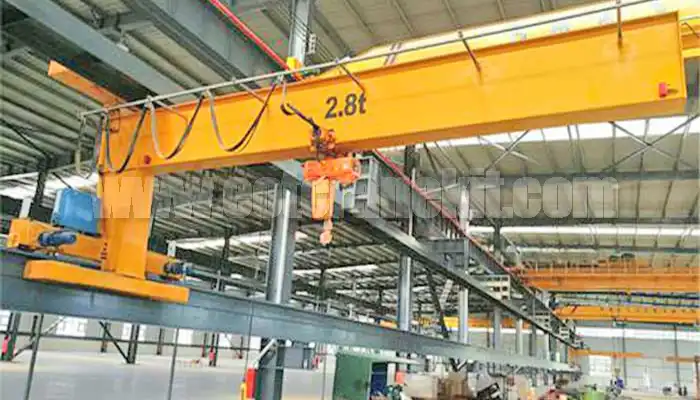
wall travelling jib crane with electric chain hoist
Electric Chain Hoist
An electric chain hoist wall travelling jib crane system is widely used in compact workshops and light to medium-duty production lines. It is simple, fast to install, and easy to operate. You can say it's the "straightforward" option.
It is suitable for:
- 1 ton and 2 ton lifting capacity
- Short lifting height applications
- Frequent lifting cycles in daily production
- Compact workstations with limited space
- Indoor metal fabrication areas
- Lower headroom requirements in workshop buildings
In practice, this type is often used where lifting is frequent but not extremely heavy. You will see it in welding corners, small machining stations, and maintenance zones.
Operators often say, "just hook it and go"—because the response is quick and direct. It works well when the movement is repetitive and short-distance.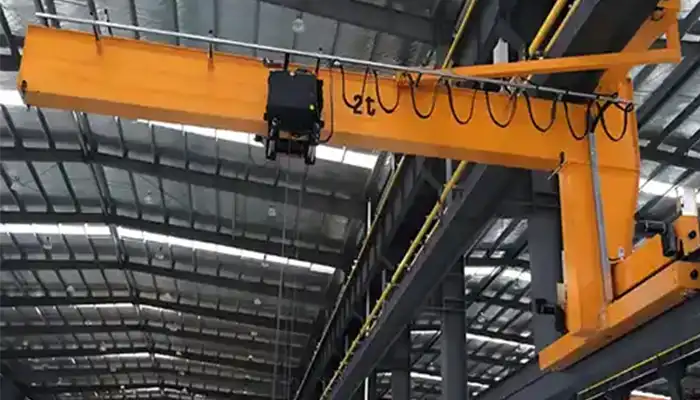 wall travelling console crane with electric wire rope hoist
Electric Wire Rope Hoist
An electric wire rope hoist wall travelling jib crane system is more commonly used in heavier and more continuous industrial environments. It is designed for stability, longer lifting height, and heavier duty cycles.
It is suitable for:
- 2 ton and 3 ton lifting capacity
- Higher lifting height requirements
- Longer duty cycles in production lines
- Heavier metal components such as shafts, rollers, and cylinders
- More stable lifting for large or long workpieces
- Continuous metal manufacturing environments
In industrial operation, wire rope hoists feel more stable during lifting. Especially when handling long steel cylinders or heavier fabricated parts—you can feel the movement is smoother, less "jerky."
This makes it a better fit for CNC + welding integrated production lines, where positioning accuracy matters more.
Practical Hoist Selection Considerations
In industrial wall mounted jib crane system design and workshop application, the final hoist selection should not be based only on tonnage. Several practical factors should be checked before final decision:
- Required lifting height inside the workshop layout
- Lifting speed needed to match production rhythm
- Duty classification (how many lifts per hour or per shift)
- Available headroom under building structure
- Type and shape of workpieces (pipes, shafts, rollers, cylinders)
- Required positioning accuracy during loading into machines
- Frequency of repeated lifting between stations
In simple terms, it's not only about "can it lift this load", but also about "can it lift it smoothly, repeatedly, and without delay during industrial production".
A properly matched hoist makes the wall travelling jib crane system feel stable, predictable, and easy to operate over long-term industrial use.
Lifting Attachments for Cylindrical Metal Workpieces
In industrial metal processing and fabrication workshops, the performance of a wall travelling jib crane system is not determined only by the crane itself. The lifting attachment plays an equally important role. Honestly, many operators will tell you—"the crane is fine, but the attachment makes the industrial difference."
For cylindrical or round steel components, proper attachment selection becomes even more critical. Pipes, shafts, rollers, and cylinders are unstable by nature—they can roll, shift, or slip during lifting if not properly supported. That is why a correct lifting attachment for wall travelling jib crane applications is essential for safe and controlled handling.
Lifting Attachment Selection Table
| Workpiece Type | Recommended Lifting Attachment |
|---|---|
| Steel pipes and tubes | Pipe lifting hooks, pipe clamps, slings, spreader beam |
| Steel shafts | Soft slings, V-block cradle, shaft lifting fixture |
| Steel rollers | Roller clamps, C-hooks, custom spreader beam |
| Hydraulic cylinders | Soft slings, protective sleeves, custom cylinder fixture |
| Steel coils | Coil hook or C-hook |
| Machined metal parts | Soft slings, protective pads, custom lifting tool |
| Steel plates or blocks | Magnetic lifter where material and surface conditions allow |
Practical Operation Note
In industrial workshop use, attachments are not "one-size-fits-all." They are selected based on shape, surface condition, and handling requirement. You can't industrially treat a polished shaft the same way as a raw steel pipe.
For example:
- A steel pipe usually needs stable gripping to prevent rolling during travel
- A machined shaft requires soft contact to avoid surface damage
- A roller or coil needs balanced support to prevent tilting
- A hydraulic cylinder often needs protection against scratches on sealing surfaces
So in practice, operators often switch between different lifting tools depending on the job of the day. It's a normal part of workshop operation.
For polished, coated, painted, or precision-machined workpieces, lifting tools must prevent scratches, dents, and surface damage. This is especially important in CNC machining workshops and hydraulic component production lines, where surface quality is part of the final product requirement.
In simple words: if the surface matters, the lifting method must be gentle and controlled.
Recommended Configurations for Different Metal Processing Areas
In industrial metal fabrication and machining workshops, a wall travelling jib crane system is not configured the same way for every working area. The setup depends on the job type, working frequency, and how precise the handling needs to be. To put it simply, welding, CNC, and long production lines all "feel different" on the shop floor, so the crane setup must match that industriality.
Below are typical recommended configurations based on actual industrial application.
Wall Travelling Jib Crane for Welding Stations
A wall travelling jib crane for welding workshop applications is designed for frequent, short-distance lifting between material racks, welding stations, and fabrication benches. The environment is usually hot, with sparks, and continuous movement of parts.
Recommended configuration:
- 1–3 ton lifting capacity
- Electric chain hoist or wire rope hoist
- Electric wall travelling mechanism
- Electric hoist trolley travel
- Wireless remote control
- Variable frequency drive (VFD) for smooth lifting and travelling
- Heat-resistant cable protection near welding areas
- Custom pipe, shaft, or cylinder lifting fixture
- Emergency stop and overload protection
In industrial operation, this setup helps operators move quickly between stations without stopping the workflow. You know, lift → move → place → next job, very direct.
Wireless control is especially useful here because welding areas are tight, and operators often need to stand at a safe distance from heat and sparks.
Wall Travelling Jib Crane for CNC Machine Loading
A wall mounted jib crane for CNC machine loading and unloading requires more precision than speed. The focus is not only lifting, but controlled positioning into machine fixtures, chucks, or tables.
Recommended configuration:
- Low-headroom electric hoist
- Slow-speed lifting function for fine positioning
- Smooth VFD trolley travel system
- Pendant control for precise operator control
- Upper and lower lifting limit switches
- Protective slings or soft lifting fixtures for machined surfaces
- Compact jib arm design for limited machine clearance
In practice, CNC loading is very sensitive work. Even a small swing can cause misalignment or surface damage, so smooth movement industrially matters.
Operators usually prefer pendant control here because it allows very fine adjustment when placing the workpiece into the machine.
Wall Travelling Jib Crane for Long Production Lines
A wall travelling jib crane system for long production line applications is used where multiple stations are arranged along a long wall—such as welding, machining, inspection, and assembly zones in sequence.
Recommended configuration:
- Wall-mounted runway beam covering multiple workstations
- Long wall travelling distance design
- Electric travelling carriage system
- Electric hoist trolley travel
- End travel limit switches for safety control
- Reliable and stable power supply system
- Multiple cranes for separate work zones when several operators work at the same time
- Customized jib arm length based on actual machine and workstation layout
In industrial factories, this kind of setup supports continuous flow. One operator at welding, another at machining, another at inspection—no waiting in between.
Limit switches and power stability are important here because the crane is running more frequently and covering longer distances.
Practical Note
In industrial wall travelling jib crane design for metal manufacturing plants, the configuration should always match the production rhythm, not just technical specifications. If the layout is right, everything flows naturally on the floor. If not, even a good crane feels "not enough."
Key Design Parameters Before Ordering
A wall travelling jib crane system must be designed based on industrial workshop conditions and actual material flow. In simple terms, the crane must fit the workshop, not the other way around.
Key parameters for wall travelling jib crane design (simplified):
Key Parameters for Wall Travelling Jib Crane Design (Simplified)
- Required lifting capacity (1T / 2T / 3T)
- Maximum load weight (including attachment)
- Workpiece size (diameter, length, drawing/photo)
- Lifting height
- Jib arm length and wall travelling distance
- Workshop layout (machine positions, stations, flow line)
- Power supply (voltage, frequency, phase)
- Control method (pendant / wireless / both)
- Working environment (indoor, outdoor, dusty, hot, corrosive)
To prepare a correct technical proposal for a wall mounted jib crane, the required information is grouped below for easy understanding:
1. Lifting Capacity & Load Information
- Required lifting capacity: 1 ton, 2 ton, or 3 ton
- Maximum workpiece weight
- Lifting attachment weight (clamps, slings, fixtures, etc.)
2. Workpiece Details
- Workpiece photos or drawings
- Diameter and length of parts
- Type of material (if available)
3. Lifting Height & Crane Dimensions
- Required lifting height
- Jib arm length
- Required jib rotation angle
- Wall travelling distance
4. Workshop Layout Information
- Workshop layout drawing
- Building column spacing
- Wall or column structural drawings
- Existing runway beam information (if available)
5. Equipment & Working Position Layout
- Location of welding stations
- Location of CNC machines
- Location of storage racks
- Location of doors and passages
- Location of production equipment and work zones
6. Electrical & Control Requirements
- Available power supply (voltage, frequency, phase)
- Control method (pendant control, wireless remote control, or both)
7. Working Condition & Operation Frequency
- Working hours per day
- Lifting frequency per hour
Operating environment:
- Indoor
- Outdoor
- Dusty environment
- High temperature area
- Corrosive environment
- Hazardous industrial conditions
Simple Practical Note
A simple workshop sketch with basic dimensions is already enough to start the initial design and quotation for a wall travelling jib crane system. No need for perfect engineering drawings at the beginning—clear layout is enough to move forward.
Building Structure and Installation Requirements
A wall travelling jib crane system transfers load directly into the workshop structure—mainly the building wall, columns, brackets, and runway beam. So before installation, the building condition must be checked properly. In industrial projects, this step is very important… because if the structure is weak, everything else is affected.
Important structural factors include:
- Column load capacity
- Wall bracket strength
- Runway beam size and support spacing
- Maximum lifting load requirement
- Crane self-weight
- Hoist and lifting attachment weight
- Jib arm length and resulting overturning moment
- Dynamic load during lifting, slewing, and travelling (this is the “industrial working force”, not just static weight)
- Operating duty classification (how often it runs per day)
- Clearance from machines, doors, pipes, and electrical systems
If the existing structure cannot support the crane, then an independent steel support frame or a freestanding crane system may be required. And honestly, this happens quite often in older workshops… so it’s not unusual.
Safety Features for Metal Processing Applications
A safe wall travelling jib crane for metal manufacturing environments must include proper electrical, mechanical, and operational safety systems. These are not optional features—they are part of normal safe operation. In practice, you don’t skip these.
Standard Safety Features
- Hoist overload limiter (prevents overloading—very important)
- Upper and lower lifting limit switches
- Hoist motor brake for load holding
- Emergency stop button
- Wall travelling limit switches
- Hoist trolley travel limit switches
- Jib rotation limit stops
- Low-voltage control system (safer operator control)
- Hook safety latch to prevent load slipping
- Warning light or audible alarm during operation
- Motor thermal protection (avoids overheating)
- Electrical phase-loss and overload protection
Additional Safety Recommendations
- VFD control for smooth acceleration and deceleration (no sudden “jerk” movement)
- Anti-sway control for accurate positioning—especially useful in CNC loading
- Wireless remote control for safer operator distance from load and welding zones
- Protective covers for welding dust, metal dust, and high-temperature areas
- Regular inspection plan for hooks, slings, clamps, and custom lifting fixtures
In industrial workshop operation, safety is not only about equipment—it is also about habits. You can have all the safety devices, but correct operation still matters every day.
A well-designed wall travelling jib crane system becomes truly safe only when structure, equipment, and operator behavior work together.
Comparison: Wall Travelling Jib Crane vs Other Handling Methods
In industrial metal processing and manufacturing workshops, material handling can be done in different ways—manual work, forklifts, overhead cranes, gantry systems, or jib cranes. But each method has its own limitation. So when people plan a production line, they usually compare options before deciding.
The wall travelling jib crane system is often chosen when the goal is to keep the floor clear, improve workflow between stations, and avoid waiting time for shared lifting equipment. In simple terms, it is about having "local lifting support" exactly where work happens.
Below is a practical comparison based on industrial workshop usage.
Handling Method Comparison Table
| Handling Method | Limitation | Wall Travelling Jib Crane Advantage |
|---|---|---|
| Manual handling | High labor intensity and injury risk | Reduces manual lifting and improves safety |
| Forklift | Requires floor space and may block workstations | Keeps floor routes clear and provides accurate positioning |
| Shared overhead crane | May be busy with other lifting tasks | Provides dedicated lifting coverage for one production line |
| Floor-mounted jib crane | Occupies floor space and has fixed coverage | Travels along the wall to serve multiple workstations |
| Gantry crane | Requires ground travel space | Suitable for localized lifting without floor rails or travel lanes |
Practical Interpretation
From industrial factory experience, each method works—but not in the same situation. Forklifts are flexible, but they move through traffic paths. Overhead cranes are powerful, but they are shared resources. Gantry cranes are mobile, but they need floor space.
The wall travelling jib crane for metal fabrication and machining lines sits in a different position. It is fixed to the building but still covers multiple stations along the wall. So operators often say: "it's always there when you need it."
This makes it especially useful for repetitive tasks like welding transfer, CNC loading, and cylindrical part handling.
Simple Conclusion for Buyers
In practical selection, the goal is not to replace all equipment, but to reduce unnecessary movement and waiting time.
A well-planned wall travelling jib crane system helps create a more direct material flow—lifting, moving, and placing parts exactly where they are needed, without interrupting other operations on the shop floor.
Maintenance Checklist for Long-Term Operation
Regular maintenance is important in metal processing workshops with welding fumes, metal dust, heat, and frequent lifting cycles.
Daily or Weekly Inspection
- Check hook condition and safety latch
- Inspect wire rope, lifting chain, slings, and clamps
- Check pendant buttons and emergency stop
- Test lifting limit switches
- Listen for unusual motor, gearbox, or brake noise
- Check for oil leakage
- Inspect cables and cable festoon system
- Check runway beam and wall brackets visually
Monthly or Scheduled Inspection
- Inspect travelling wheels and bearings
- Check bolt tightness on wall brackets and runway beam supports
- Lubricate gears and bearings as required
- Test overload protection and braking performance
- Check electrical control panel and contactors
- Inspect jib arm alignment and rotation mechanism
- Review lifting attachment wear and certification status
When a Wall Travelling Jib Crane Is Not the Best Solution
A wall travelling jib crane may not be suitable when:
- The building wall or columns cannot support the crane load
- The lifting area must cover the entire workshop width
- The load exceeds 3 tons
- Long-distance transport between multiple bays is required
- The application requires outdoor operation without structural support
- Multiple large loads must be moved simultaneously across a wide area
Alternative solutions may include a freestanding jib crane, monorail crane, workstation crane, semi-gantry crane, portable gantry crane, or overhead bridge crane.
Buyer Inquiry Checklist: Request a Customized Solution
To receive a suitable 1 ton, 2 ton, or 3 ton wall travelling jib crane for metal processing, prepare the following information:
- Maximum lifting capacity required
- Maximum workpiece weight
- Lifting fixture or attachment weight
- Workpiece photo or drawing
- Workpiece diameter, length, and lifting points
- Required lifting height
- Required jib arm length
- Required wall travelling distance
- Workshop layout drawing or hand sketch
- Building column and wall structure photos or drawings
- Existing runway beam information, if available
- Available power supply
- Required control method
- Working hours and lifting frequency
- Operating environment, including welding fumes, metal dust, heat, corrosion, or outdoor exposure
- Required lifting attachment, such as pipe clamp, C-hook, magnetic lifter, soft sling, or custom fixture
Conclusion: Send Us An Inquiry
A 1–3 ton wall travelling jib crane is a practical lifting solution for metal processing and manufacturing facilities that need to move cylindrical workpieces, steel pipes, shafts, rollers, and fabricated components between welding, machining, assembly, and inspection stations.
It creates a dedicated lifting system along the production line, reduces forklift congestion, improves positioning accuracy, keeps floor space clear, and supports safer handling of heavy metal parts.
Send your workpiece drawing, maximum load, workshop layout, jib arm length requirement, wall travelling distance, and building structure photos. A customized wall travelling jib crane solution can then be designed with the correct capacity, hoist type, runway beam, control method, and lifting attachment for your production line.

Article by Bella ,who has been in the hoist and crane field since 2016. Bella provides overhead crane & gantry crane consultation services for clients who need a customized overhead travelling crane solution.Contact her to get free consultation.